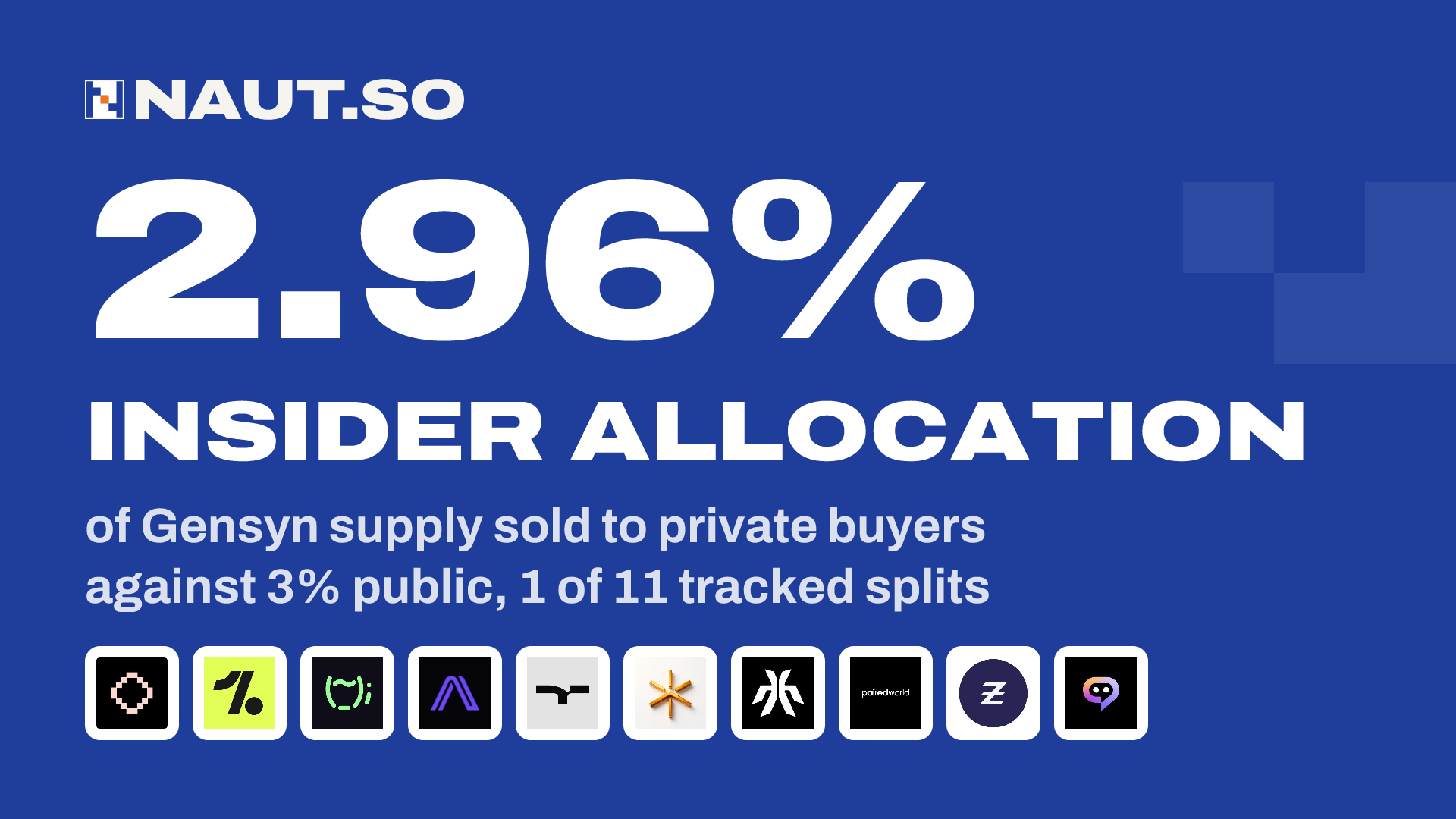
Crypto token insider allocation is the share of a token's total supply sold to private buyers before the public sale, and NAUT stores it as a pair of fields on a company record: a private sale percentage and a public sale percentage. NAUT's data shows that on 8 November 2026, 302 of its 10,586 live company rows carry both fields, 11 carry both above 0 on a launched token, and 10 of those 11 also carry the full supply, raise and float figures this check needs, from MicroGPT at 27% private against 20% public down to PairedWorld at 0.15% against 6%.
Data note. Every figure here was read from NAUT's own database on 8 November 2026, read-only. The pair of fields covers the 2 sale slices of a token supply, so it measures what private buyers bought and what the public sale offered, and NAUT holds no separate team, treasury or advisor percentage inside this pair. NAUT's private sale price, public sale price and the 2 ROI columns are empty on every row, so no insider entry price and no ROI multiple appears below. 6 claims about 3 of the 10 tabled tokens were put to outside sources: 3 are used here, 1 about the token sale's final valuation came back contradicted and is left out along with Gensyn's stored valuation figure, and 2 came back confirmed on a page where the quote could not be located, so they are left out too. The other 7 of the 10 rows were never read outside NAUT. Gensyn also carries 2 ICO-type funding rows with different amounts and 1 of them with no date, so both are held back here as a record defect and no token sale amount is printed. NAUT Research wrote it.
Crypto token insider allocation, in 4 steps
The 4 steps run on 1 token at a time, and they take about 5 minutes each once you know where the fields sit.
- Step 1 is a filter, and it is the step that fails most often. Of 10,586 live company rows, 302 carry both split fields and 11 carry both above 0 on a launched token.
- Step 2 is the read itself: private share, public share, and the ratio between them.
- Step 3 puts that split next to initial float and total raise, which is what turns a percentage into a sell-pressure question.
- Step 4 is the cross-check, because a stored tokenomics figure is a record of what a project published and can be short, stale or doubled up.
- Filter for a usable row302 of 10,586 live NAUT company rows carry both split fields, 11 above 0 on a launched token, 10 with the full set.
- Read the 2 sharesGensyn holds 2.96% private against 3% public, a ratio of 0.99, the 3rd lowest private share of the 10.
- Add float and raiseGensyn sold 5.96% of supply across both slices on a 13.1% initial float and a $50,600,000 stored raise.
- Cross-check the recordTea Protocol stores a $19,000,000 raise where a public funding tracker puts it at $16,900,000.
Step 1: check the token launched and the row carries both fields
Open the project on NAUT and look for a launched token with both percentages filled. 302 of the 10,586 live, non-merged company rows carry a private and a public percentage together, which is 2.9% of the directory, and most of that 302 sits at 0 on one side or both. 11 rows carry both above 0 with the token already launched, and 10 of those 11 also carry total supply, initial float and total raise, so the 11th drops out of the table below for a missing figure rather than a missing split.
That sparsity is the first thing worth knowing about this data. A project with no stored split has not been cleared, it has not been measured, and the answer for it has to come from the project's own tokenomics page.
Step 2: read the private share against the public share
Take the 2 percentages and divide them. A ratio above 1 says private buyers were allocated more supply than the public sale offered, and a ratio below 1 says the public slice was the larger of the 2.
Across the 10 tracked tokens the split lands 5 each way: MicroGPT, Arcium, Tea Protocol, OneFootball and Tap Protocol sold more supply privately than publicly, and Zephyr, XMAQUINA, Gensyn, Atlas Ora and PairedWorld did the reverse. The spread on the private side runs from 27% down to 0.15%, a factor of 180, so there is no house standard to compare a new deal against.
Step 3: put the split next to float and raise
A private share means 1 thing at a 5% float and another at a 35% float. Arcium is the clearest case in this set: 26.2% of supply went to private buyers and its stored initial float is 0, so on NAUT's record nothing was circulating at launch while the 2nd largest private allocation in the table sat behind it. At the other end, OneFootball holds a 15.03% private share against a 35.68% initial float, the highest float of the 10.
Read the raise in the same breath. The 2 sale slices add to 5.96% of supply at Gensyn against a $50,600,000 stored total raise, and to 47% of supply at MicroGPT against $1,540,000. Selling nearly half the supply to raise $1,540,000 is a different deal from selling 6% of it to raise $50,600,000, and the percentages alone hide that.
Step 4: cross-check the stored figure before you act on it
Every number in steps 1 to 3 is a record of something a project published, so check it against the project's own page and 1 outside source before it goes in a memo. 2 checks in this set came back worth printing. A public funding tracker puts Tea Protocol at $16,900,000 raised across 2 seed rounds, where NAUT stores $19,000,000, and public token trackers list a fixed total supply of 10,000,000,000 for Gensyn's token, which matches NAUT's stored figure exactly.
Then check who the private buyers were, which is a different question from how much they bought. NAUT's round records name the firms, and that list is the one a founder or an investor actually works from.
How much of each token's supply went to private buyers?
Ranked by stored private sale share of total supply, largest first, all 10 read on 8 November 2026. The ratio column is private divided by public, rounded to 2 decimals.
| Token | Private % | Public % | Ratio | Initial float % |
|---|---|---|---|---|
 MicroGPT |
27 | 20 | 1.35 | 11.8 |
 Arcium |
26.2 | 2 | 13.10 | 0 |
 Tea Protocol |
19.36 | 4 | 4.84 | 20 |
 OneFootball |
15.03 | 6 | 2.50 | 35.68 |
 Zephyr |
14 | 21 | 0.67 | 18.22 |
 Tap Protocol |
12.52 | 7.5 | 1.67 | 5.95 |
 XMAQUINA |
8 | 30 | 0.27 | 26.94 |
 Gensyn |
2.96 | 3 | 0.99 | 13.1 |
 Atlas Ora |
1.8 | 23.75 | 0.08 | 19.5 |
 PairedWorld |
0.15 | 6 | 0.03 | 5.26 |
3 of the 4 largest private shares sit at projects with a stored raise of $19,000,000 or less, and the 4th, OneFootball at 15.03%, sits behind the largest raise in the set at $310,000,000. The next largest raise, Gensyn at $50,600,000, carries the 3rd lowest private share at 2.96%. So the direction across these 10 rows is loose rather than clean, and 10 rows are too few to call it a pattern either way.
What is Gensyn's crypto token insider allocation?
Gensyn is a decentralised compute protocol for machine learning, and its NAUT record holds the full set the 4 steps need. Private buyers were allocated 2.96% of a 10,000,000,000 token supply, which is 296,000,000 tokens, and the public sale slice is 3%, or 300,000,000 tokens. The 2 together are 5.96% of supply, the smallest combined sale share of the 10, on a 13.1% initial float.
Step 3 then asks what those private buyers paid in, and NAUT's record answers it round by round. The 3 pre-token rounds add to exactly the $50,600,000 stored as the total raise, which is the cleanest internal check this data offers.
| Round | Amount | Backer firms named |
|---|---|---|
| Pre-Seed Round | $1,100,000 | 0 |
| Seed Round | $6,500,000 | 7 |
| Series A Round | $43,000,000 | 8 |
NAUT names 10 distinct firms across those 2 later rounds: CoinFund, Galaxy Digital (Ventures), PEER VC, Zee Prime Capital, Maven 11 Capital, Jsquare and Hypersphere Ventures on the seed, and Andreessen Horowitz (a16z), Canonical Crypto and Protocol Labs joining 5 of those 7 on the Series A. 5 firms appear on both rounds. None of the 10 carries a lead flag on NAUT's record, and the press coverage of the round settles that question: Decrypt's item of 12 June 2023 is headlined "Gensyn AI Secures $43M for Decentralized Machine Learning Led by a16z". So the backer list is NAUT's record of who bought the private allocation, and the lead within it came from the source rather than the field.
NAUT's record also carries no announce date on those 3 pre-token rounds, which is why no funding timeline appears here.
What this tells a founder raising and an investor sourcing
The split is a negotiating reference for 1 side and a diligence input for the other, and the same 10 rows serve both.
- A founder setting sale terms has 10 tracked comparables and a range from 0.15% to 27% on the private side, so the honest answer to "what is normal" is that this sample shows no normal.
- An investor sourcing a pre-token deal gets more out of the ratio than the percentage. A ratio of 13.10 at Arcium against 0.99 at Gensyn says 2 very different things about who the supply was sold to.
- Either way the read ends in a name. NAUT's round records name 10 firms behind Gensyn's private rounds, and every one of them has a NAUT page with its team on it.
- Where no split is stored, the project's own tokenomics page is the next stop, and that is the case for 10,284 of the 10,586 live company rows.
- Pick your comparable5 of the 10 sold more supply privately than publicly, and 5 did the reverse.
- Read float with itArcium pairs a 26.2% private share with a 0 stored initial float.
- Price the raise against itMicroGPT sold 47% of supply across both slices to raise $1,540,000.
- Go to the buyersNAUT names 7 firms on Gensyn's seed and 8 on its Series A, 10 firms in total.
How to reach the teams and the funds behind these tokens
Each of the 10 projects has a NAUT page with its people, their roles and the channels NAUT holds on file, and each of the 10 firms named on Gensyn's rounds has an investor page with the same. For a founder benchmarking sale terms, the useful note is the one that starts with the comparable: 2.96% private against 3% public on a 10,000,000,000 supply is a specific question to put to a fund that bought into exactly that structure.
Work it in that order. Read the split, pick the 2 or 3 rows closest to your own terms, then open the backer pages behind those rows rather than the project pages, because the firms that priced a private allocation once will price the next one.
Related reading on NAUT: Crypto token unlocks: Monad's 6.84B cliff after 12 months at 0 and What is a TGE: 22 token launches and the $11.56B behind them.
Can you pull this data through the NAUT API?
Yes, through the project endpoints. GET https://api.naut.so/v1/projects?token=launched&limit=100 with an Authorization: Bearer $NAUT_KEY header returns launched-token company records 100 to a page at 5 credits a call, and GET https://api.naut.so/v1/projects/gensyn returns the worked example above as 1 company with its team for another 5 credits. Parameters and quotas are at naut.so/docs/api, and plans start at $49 a month for 3,000 credits at naut.so/pricing. Verified Telegram, email and LinkedIn for the people on those records unlock on any paid NAUT plan, so start a 7-day trial before you run the pull.
Crypto token insider allocation FAQ
How much of a token supply goes to insiders?
On the 10 NAUT-tracked tokens that carry a full split on 8 November 2026, the private sale share of total supply runs from 0.15% at PairedWorld to 27% at MicroGPT, with Gensyn at 2.96%. 5 of the 10 sold more supply to private buyers than their public sale offered, and 5 sold less, so a single typical figure does not come out of this sample.
How do I check a crypto token's insider allocation on NAUT?
Open the project page, read the private and public sale percentages, divide 1 by the other, then read the initial float and the total raise beside them. 302 of NAUT's 10,586 live company rows carried both percentages on 8 November 2026, and 11 carried both above 0 on a launched token, so the check runs on tracked tokens with populated tokenomics rather than on every project.
What was Gensyn's private sale allocation?
NAUT's data shows 2.96% of Gensyn's 10,000,000,000 token supply was allocated to private buyers, or 296,000,000 tokens, against a 3% public sale slice and a 13.1% initial float. Its 3 pre-token rounds on NAUT's record add to $50,600,000, and the Series A at $43,000,000 was led by Andreessen Horowitz (a16z) according to Decrypt's 12 June 2023 report.
Does a high private allocation mean a bad token allocation?
By itself it means very little, because the number only reads against the float and the raise. Arcium holds the 2nd highest private share of the 10 at 26.2% with a 0 stored initial float, while MicroGPT sold 47% of supply across both slices to raise $1,540,000, and those 2 rows describe different risks.
Where can I find the funds that bought these private allocations?
NAUT holds an investor page for each of the 10 firms named across Gensyn's seed and Series A rounds, with the team and the channels on file, and GET https://api.naut.so/v1/investors/<slug> returns 1 fund with its team and portfolio for 5 credits. Verified Telegram, email and LinkedIn unlock on any paid NAUT plan, so start a 7-day trial to reach them.
Sources
- NAUT's own database, read on 8 November 2026, read-only: the private and public sale percentages, total supply, initial float and total raise on every live, non-merged company row, plus the funding records and backer rows behind Gensyn. Every count above was computed from those rows at that time.
- Gensyn's Series A amount and lead: decrypt.co, dated 12 June 2023, with tech.eu as a second source.
- Gensyn's token supply: coingecko.com, with coinmarketcap.com as a second source.
- Tea Protocol's raise: coincarp.com, with icodrops.com as a second source.
- NAUT API parameters and prices: naut.so/docs/api and naut.so/pricing.