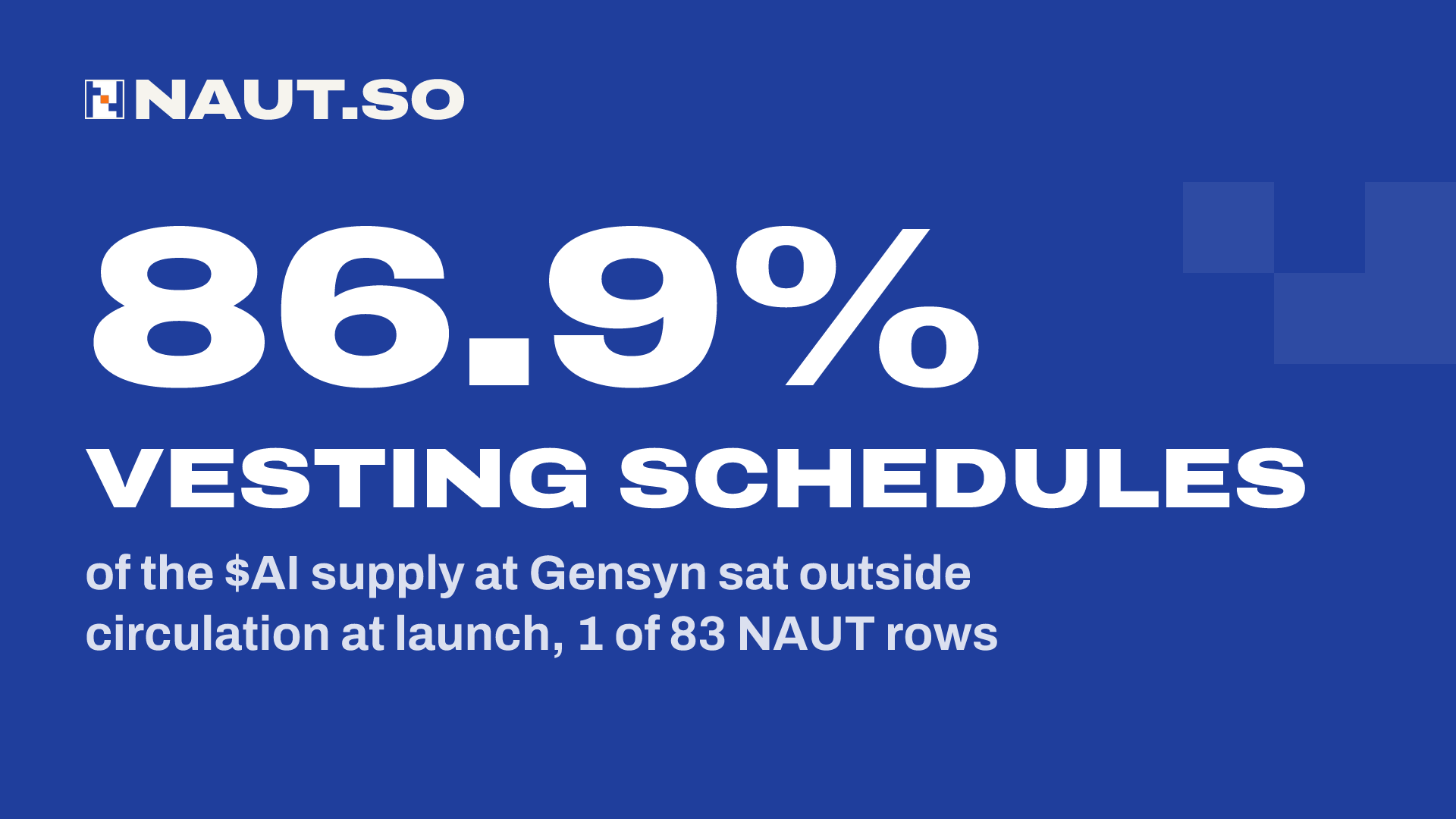
What is a vesting schedule in crypto: it is the calendar that says when each allocation of a token supply becomes transferable, built from a cliff (a period at 0 released), a lockup (the share still frozen) and a linear release (the drip that follows). NAUT holds a stored initial circulating share for 83 project records, read on 4 November 2026, and in the worked record below Gensyn put 13.1% of its $AI supply into circulation at launch and left 86.9%, or 8,690,000,000 of 10,000,000,000 tokens, outside it.
How this was built: on 4 November 2026 NAUT read its own tokenomics fields (initial circulating share, private sale share, public sale share, total supply, total raise and fully diluted valuation) for the projects that carry them. 83 project records hold an initial circulating share. 20 of those rows were pulled in full for this article and 2 were dropped, because their stored percentage fields hold values above 100, which no percentage field can mean. That leaves 18 usable rows, 3 of them with a live token. The table holds 11 of the 18: the 3 with a live token, plus the 8 pre-launch rows with the largest stored raise figure. For those 8 pre-launch rows the stored raise is the total the project's own NAUT description names for its sale, which in several cases is a target rather than money already in.
Of the 11 rows in the table, 3 had a figure checked against an outside source on 4 November 2026: the raise at Gensyn, the raise at OneFootball and the launch float at Tea Protocol. The other 8 rows carry NAUT's stored tokenomics record and nothing more, so read them as what NAUT holds on 4 November 2026 rather than as a term sheet. NAUT's record for Mystiko also carries a warning in its own description that the token has been delisted from several exchanges while the team stays active, so its stored launch plan is history rather than a schedule to come.
What is a vesting schedule in crypto?
A token vesting schedule is 3 numbers and a calendar. The first number is the share of total supply that is transferable on day 1, which NAUT stores as the initial circulating share. The second is the remainder, locked at launch, which can only move when the schedule says so. The third is the length of the release, counted in months from the token generation event.
Each allocation in a cap table (team, investors, treasury, community, liquidity) gets its own line on that calendar, and the lines rarely match. A seed investor and a market maker who both hold 2% of supply can be 36 months apart on when they can sell it.
What is a vesting schedule made of: the cliff and the linear release
The cliff comes first. It is a fixed stretch after launch in which an allocation releases 0 tokens, so a holder with a 12-month cliff owns the allocation on paper and can move none of it until month 12 arrives. Then the linear release starts, and the allocation unlocks in equal monthly or quarterly slices until it is fully vested.
Published tokenomics guides describe a 12-month cliff followed by a linear release over 24 to 36 months as the common shape for a crypto venture allocation, with early rounds pushed further out again, and the reason given is the same in each: an investor who cannot sell for a year is holding the same risk as the team (Colin Dijs, TokenMinds). Those are industry write-ups rather than any single project's signed terms, so treat the shape as the market default and read the project's own docs for the actual months.
Which NAUT records show the most supply locked at launch?
11 rows, ranked by the share of total supply locked at launch, highest first. Every figure is NAUT's stored tokenomics record, read on 4 November 2026. Float is the share of total supply circulating at launch, Locked is the rest of the supply, and Private and Public are the sale shares. 3 of the 11 carry a live token: Gensyn, Tea Protocol and OneFootball.
| Project | Float | Locked | Private | Public |
|---|---|---|---|---|
 Mystiko |
3.13% | 96.87% | 27.5% | 7.5% |
 Atleta Network |
3.33% | 96.67% | 29.89% | 0.1% |
 Gensyn |
13.1% | 86.9% | 2.96% | 3% |
 Lahara |
15% | 85% | 0% | 15% |
 Tea Protocol |
20% | 80% | 19.36% | 4% |
 Nexchain |
24.35% | 75.65% | 12% | 20% |
 Use.com |
35% | 65% | 15% | 35% |
 OneFootball |
35.68% | 64.32% | 15.03% | 6% |
 Coldware |
50% | 50% | 50% | 0% |
 BMIC Crypto Wallet |
66% | 34% | 10% | 50% |
 Neo Pepe |
100% | 0% | 0% | 45% |
Across all 18 usable rows the median initial circulating share is 29.68%, 16 of the 18 keep at least half of supply locked at launch and 9 of the 18 keep at least 75% of it locked. The widest and the narrowest schedules both sit in the table: Mystiko at 3.13% circulating, and Neo Pepe at 100%, a stored record with nothing on a schedule at all.
The sale columns are where a schedule shows itself. In 5 of the 11 rows the private and public sale shares together are larger than the share circulating at launch, so part of what buyers paid for is still frozen on day 1: Nexchain, Atleta Network, Use.com, Mystiko and Tea Protocol.
How much supply is locked at launch across these records?
Neo Pepe is left out of the chart because its stored locked share is 0%.
How much of Gensyn's supply was locked at launch?
Gensyn is the cleanest worked record of the 18. It is a DePIN protocol for deep learning compute that pays users for sharing GPU and CPU power, and NAUT's record puts its total raise at $50.6M and its token at a $1B fully diluted valuation on a total supply of 10,000,000,000 $AI. A report on the token sale and a company profile both carry the same $50.6M total and the same $1B valuation cap, and the report names the seed and Series A leads (Bitget, Tracxn). Gensyn's own NAUT page lists the backers NAUT has on file against it.
Run the schedule arithmetic on that record:
- 13.1% circulating at launch is 1,310,000,000 $AI, and the 86.9% locked is 8,690,000,000 $AI.
- The private sale took 2.96% of supply and the public sale 3%, so 5.96% in total went to buyers against the 13.1% that was transferable on day 1.
- At a $1B fully diluted valuation, the locked 86.9% carries $869M of the valuation and cannot be sold on the day the market opens.
That last line is the number a deal maker needs. A token trading against 13.1% of its supply is trading against 13.1% of the thing being valued, and every month of the schedule moves more of the other 86.9% into the market.
Tea Protocol is the row with the launch float stated in public by an outside source as well as in NAUT's record. Its filing coverage says "roughly 20% of that supply will be unlocked and entering circulation at the time of the mainnet launch" (CryptoBriefing, Incrypted), which matches the 20% NAUT stores against it. OneFootball is the third live token here, a football media platform whose raise of $310M is reported with Adidas leading the round (KuCoin), and NAUT's record releases 35.68% of its supply at launch.
What this tells a founder raising a token round
- The initial circulating share is a term you negotiate, and it is public the moment the token launches, so pick a number you can defend to the next round.
- A 12-month cliff on investor and team allocations is the market default described in published guides, which makes a shorter cliff the thing a diligence call will ask about.
- Selling more supply than you intend to circulate is normal in this data, in 5 of the 11 rows here, as long as the schedule behind it is written down.
- The buyers on your cap table read each other's schedules. A market maker unlocking in month 3 next to a seed fund unlocking in month 12 is a conversation you want to have before signing, rather than after.
- Fix the launch floatThe 18 NAUT rows run from 3.13% circulating at Mystiko to 100% at Neo Pepe, median 29.68%.
- Set the cliffPublished guides put the common crypto venture allocation at a 12-month cliff and a 24 to 36 month linear release.
- Check the sold share against itIn 5 of the 11 rows the private plus public sale shares exceed the launch float.
- Publish the arithmeticGensyn shows 13.1% circulating and 8,690,000,000 $AI locked, which anyone can recompute.
What this tells an investor sizing a token deal
- The locked share is the overhang. At a $1B fully diluted valuation and 86.9% locked, $869M of the valuation is waiting on a calendar.
- A row with a high launch float has less to come: BMIC Crypto Wallet stores 66% circulating at launch, and Coldware 50%.
- The private sale share tells you who else is in line. 29.89% at Atleta Network and 27.5% at Mystiko are the largest private allocations in the table.
- Before an introduction, read the project's NAUT page for the team and the backers on file, then take the schedule to the project's own docs.
- Read the launch floatNAUT stores an initial circulating share for 83 project records, read on 4 November 2026.
- Size the overhang16 of the 18 usable rows keep at least half of supply locked, and 9 keep at least 75%.
- See who is ahead of youThe private sale share runs up to 29.89% at Atleta Network in this table.
- Open the page and the peopleEach project's NAUT page carries its team and the backers NAUT holds against it.
Related reading on NAUT: Crypto token unlocks: Monad's 6.84B cliff after 12 months at 0 and What is a TGE: 22 token launches and the $11.56B behind them.
Can you pull this data through the NAUT API?
Yes. The record worked through above comes back from GET https://api.naut.so/v1/projects/gensyn with an Authorization: Bearer $NAUT_KEY header, which returns the company with its team, and the wider set of live-token rows comes from GET https://api.naut.so/v1/projects?token=launched&limit=100. Each data call costs 5 credits, plans start at Essential $49 a month for 3,000 credits, and the parameters are listed in the API docs and the pricing page. The verified Telegram, email and LinkedIn of the people on those project pages unlock on any paid NAUT plan, so start a 7-day trial if you need to reach them.
What is a vesting schedule FAQ
What is a vesting schedule in crypto?
A vesting schedule is the calendar that sets when each token allocation becomes transferable, written as a cliff at 0 released, then a linear release over a fixed number of months, with the untouched remainder described as locked. On NAUT's records, read on 4 November 2026, Gensyn launched $AI with 13.1% of supply circulating and 86.9%, or 8,690,000,000 tokens, locked.
What is a token cliff, and how long is it usually?
A cliff is the stretch straight after a token launch in which an allocation releases nothing at all, so the holder can move 0 tokens until it ends. Published tokenomics guides describe a 12-month cliff followed by a 24 to 36 month linear release as the common shape for a crypto venture allocation (Colin Dijs, TokenMinds).
How do crypto token lockups work?
A crypto token lockup is the frozen half of the schedule: the allocation sits in the holder's name, releases nothing while the cliff runs, then unlocks in equal slices across the linear release. NAUT's record for Gensyn, read on 4 November 2026, shows 8,690,000,000 of 10,000,000,000 $AI locked at launch against 1,310,000,000 circulating.
How much of a token supply is usually locked at launch?
Across the 18 usable NAUT tokenomics rows read on 4 November 2026, the median initial circulating share is 29.68%, 16 of the 18 keep at least half of supply locked at launch, and 9 of the 18 keep at least 75% locked. The range in those rows runs from 3.13% circulating at Mystiko to 100% at Neo Pepe.
Which of these projects already have a live token?
3 of the 18 usable rows carry a live token as of 4 November 2026: Gensyn at 13.1% circulating at launch, Tea Protocol at 20% and OneFootball at 35.68%. The other 15 rows store a planned launch allocation rather than a token already trading.
Where can I find a project's tokenomics and the people to contact on NAUT?
Each project page on NAUT carries the stored tokenomics record, the team and the backers on file, for the 83 project records that hold an initial circulating share and for the rest of the directory, and GET https://api.naut.so/v1/projects/gensyn returns the same record for a single slug. The verified Telegram, email and LinkedIn of those people unlock on any paid NAUT plan, so start a 7-day trial to open the channels.
Sources
- NAUT's own tokenomics records, read on 4 November 2026: initial circulating share, private and public sale shares, total supply, total raise and fully diluted valuation. 83 project records hold an initial circulating share, 20 rows were pulled in full, 2 were dropped for stored percentage values above 100, and 18 remain usable.
- Gensyn's $50.6M total raise and $1B valuation cap: Bitget and Tracxn.
- Tea Protocol's roughly 20% launch circulation: CryptoBriefing and Incrypted.
- OneFootball's $310M raise with Adidas leading: KuCoin.
- The cliff and linear release shape for a crypto venture allocation: Colin Dijs and TokenMinds.
- The 8 pre-launch rows in the table were not put through an outside source check, so their stored raise figures and launch allocations are NAUT's record on 4 November 2026 only.