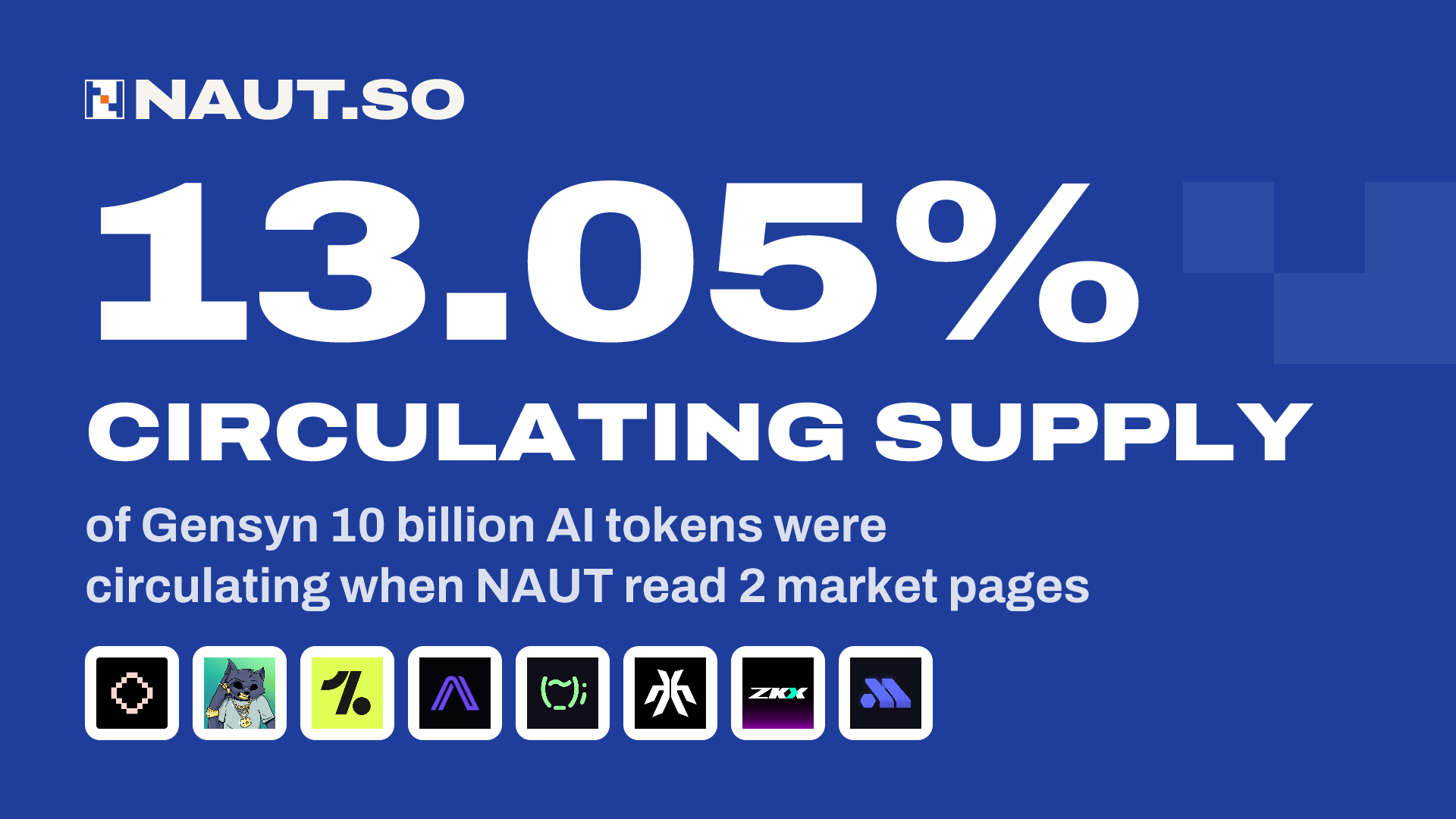
A token's circulating supply is the count of its tokens trading today, and you check it in 3 steps: read the project's stored crypto tokenomics fields on NAUT, turn the percent into a token count against total supply, then re-read the live figure on a market page before you price anything off it. NAUT tracks 18 launched tokens that carry all 3 of those fields, and on the token worked through below, Gensyn, 1,304,675,313 of 10,000,000,000 AI tokens were circulating when NAUT read 2 market pages on 4 November 2026, which is 13.05% of the supply.
Data note. The token records here were read from NAUT's own database on 4 November 2026, read-only. 18 launched projects carry a stored initial circulating percent, a stored fully diluted valuation and a stored total supply all 3. 1 of those 18, Symphony, stores 104.5% initial circulating, which cannot happen, so it is out of every count, table, chart and average below and 17 rows remain. The live figures for Gensyn come from 2 pages NAUT fetched itself on 4 November 2026, CoinGecko's API record for the token and CoinMarketCap's Gensyn page, both of which answered HTTP 200 and agree on circulating supply to the token. cryptorank.io/price/gensyn answered HTTP 403 to NAUT's fetch that day, so nothing here rests on it. Research put 6 claims to outside pages on 4 November 2026: 2 of the 6 are used here, the $50,600,000 private raise and Andreessen Horowitz (a16z) leading the Series A, and 1 came back contradicted, the price the public token sale settled at, so no sale price or public-sale amount appears in this article. The stored fields of the other 16 rows were not put to any outside page: they are NAUT's own record on that date.
How to check a token's circulating supply in 3 steps
Circulating supply answers 1 question a screen rarely answers for you: of everything that will ever exist, how much is loose right now, and who holds the rest. 3 steps get you there from a NAUT project page, and 2 more turn the answer into something a deal maker can act on.
- Step 1, read the 3 stored fields. On a NAUT project page, initial circulating percent, total supply and fully diluted valuation sit together. Gensyn stores 13.1%, 10,000,000,000 AI and $1,000,000,000.
- Step 2, turn the percent into tokens. 13.1% of 10,000,000,000 is 1,310,000,000 AI loose at launch, so 8,690,000,000 were held back by the treasury, the team and the investors who had not vested.
- Step 3, re-read it live. CoinGecko and CoinMarketCap both put circulating supply at 1,304,675,313 on 4 November 2026, 13.05% of a total and max supply of 10,000,000,000. The stored field and the live read are 0.05 of a percentage point apart here, which is the exception rather than the rule across a set of launch-time records.
- Step 4, price the float. Market cap counts only the circulating part. CoinGecko put Gensyn's market cap at $21,086,869 against a fully diluted valuation of $161,625,415 on 4 November 2026, so 87% of the valuation sits in tokens that were not trading yet.
- Step 5, find out who holds the rest. NAUT's record for Gensyn lists $50,600,000 raised across a pre-seed, a seed and a Series A round, with 15 backer rows naming 10 distinct firms across 2 of those rounds. Those are the holders whose unlocks move the first 3 numbers.
- Read the 3 stored fieldsGensyn stores 13.1% initial circulating, 10,000,000,000 total supply and a $1,000,000,000 FDV.
- Turn percent into tokens13.1% of 10,000,000,000 is 1,310,000,000 AI loose at launch and 8,690,000,000 held back.
- Re-read it live1,304,675,313 AI circulating on 4 November 2026, 13.05%, on 2 pages that agree to the token.
- Price the floatA $21,086,869 market cap against a $161,625,415 FDV puts 87% of the value in tokens not trading.
- Find the holdersNAUT lists $50,600,000 raised across 3 private rounds and 10 distinct backer firms.
What is the circulating supply of Gensyn's AI token?
1,304,675,313 AI out of a total and max supply of 10,000,000,000, read on 4 November 2026, which is 13.05% of everything that will ever exist. CoinGecko's API record and CoinMarketCap's Gensyn page carried the same circulating figure to the token that day, and their fully diluted valuations were $161,625,415 and $161,503,750, a difference of 0.08%.
That live 13.05% lands close to the 13.1% NAUT stores as Gensyn's initial circulating percent. The useful part of the exercise is the other stored field. NAUT's fully diluted valuation for Gensyn reads $1,000,000,000, a launch-time record, while the live read on 4 November 2026 was $161,625,415, so the stored field was 6.2x the live one. A stored FDV dates itself the moment a token trades, and the research pass found that NAUT's $1,000,000,000 does not describe where the public sale settled either, so it belongs in a deal memo as a historical marker.
NAUT's own record also disagrees with itself on what the public sale raised: it holds 2 separate public-sale rows with different amounts and a third figure inside the company description. That is why no sale amount is quoted anywhere above, and it is the same discipline the live check applies. A stored number is a lead worth 1 more click.
On the private side the record is clean and useful. $50,600,000 across 3 rounds, confirmed on 4 November 2026 against CoinDesk's June 2023 report of the $43,000,000 Series A and the round pages behind NAUT's row. Andreessen Horowitz (a16z) is on NAUT's Series A backer rows and CoinDesk reported it led that round. Galaxy Digital (Ventures) is on the seed rows. NAUT's backer rows carry no lead flag on any of the 15, so the lead on the Series A comes from the outside page rather than from the stored record.
How does circulating supply compare across 17 NAUT token records?
NAUT stores token circulating supply as a launch-time percent, which is what makes this set comparable across projects and what makes step 3 mandatory on any single one of them. Across the 17 usable rows, initial circulating percent runs from 0% to 73%, the average is 19.8% and the median is 18.22%. 10 of the 17 launched under 20%, 6 of those under 10%, and 3 launched at 0%, meaning the stored record says nothing was loose on day 1. The table is ranked by initial circulating percent, highest first.
| Token | Initial float | Stored FDV |
|---|---|---|
 CATS Token |
73% | $79,820,000 |
 DexToro |
42.19% | $10,472,584 |
 Jurassic Finance |
38.76% | $516,000 |
 OneFootball |
35.68% | $50,000,000 |
 XMAQUINA |
26.94% | $45,000,000 |
 ZKX |
20% | $50,000,000 |
 Tea Protocol |
20% | $50,000,000 |
 Atlas Ora |
19.5% | $25,000,000 |
 Zephyr |
18.22% | $10,000,000 |
 Gensyn |
13.1% | $1,000,000,000 |
 MicroGPT |
11.8% | $3,500,000 |
 Tap Protocol |
5.95% | $75,000,000 |
 BAD coin |
5.6% | $12,500,000 |
 PairedWorld |
5.26% | $39,000,000 |
 Arcium |
0% | $200,000,000 |
 Moemate |
0% | $60,000,000 |
 Bitway |
0% | $5,000,000 |
Both columns are stored fields read on the same date, not live reads, and each project page carries the total supply that turns the percent into a token count, which is the step 2 arithmetic run on Gensyn above. Only Gensyn in this set had its live circulating supply read against outside market pages for this article, so the other 16 rows stand as launch-time records that each need step 3 run on them before anyone prices them.
Initial circulating percent across the 17 NAUT token records
The 3 bars at 0%, Arcium, Moemate and Bitway (prev. Side Protocol), are the clearest case for step 3: a stored 0% dates the record to before the token traded, so the live page is the only place the current float exists.
What this tells a deal maker checking circulating supply
Circulating supply is a sourcing filter as much as a valuation input, because the percent tells you which stage of its life a project is in and who still has to be paid.
- A thin float marks a young record. 10 of the 17 rows launched under 20%, and a project in that band usually still has its founding team in place, which makes it a reachable company rather than a settled one.
- A stored FDV ages fastest of the 3 fields. Gensyn's stored $1,000,000,000 against a $161,625,415 live read is 6.2x, so a target list sorted by stored FDV sorts by launch-day ambition.
- The holders are findable. NAUT's Gensyn record lists 10 distinct backer firms across 2 of its 3 private rounds, and each firm has its own NAUT page with its team on it, so the people behind the 86.95% that was not trading are 2 clicks from the token page.
- A founder raising should expect both numbers on the table. 87% of Gensyn's valuation sat in tokens that were not trading on 4 November 2026, and that gap is what an investor prices against your ask.
- 0% at launch is a question rather than a red flag. 3 of the 17 rows store it, and each needs the live read before anything else is said about them.
- Sort by float band10 of the 17 rows launched under 20% circulating, 6 of them under 10%, 3 at 0%.
- Run step 3 on the shortlistOnly Gensyn was read live here, at 1,304,675,313 of 10,000,000,000 on 4 November 2026.
- Price the gapA $21,086,869 market cap against a $161,625,415 FDV is 87% of the value still locked.
- Open the backer pagesNAUT lists 10 distinct firms across 2 of Gensyn's 3 private rounds, each with its own team page.
- Reach 1 named personEach project page names the team NAUT holds, so the note goes to a person rather than an inbox.
Related reading on NAUT: What is a TGE: 22 token launches and the $11.56B behind them and Crypto token unlocks: Monad's 6.84B cliff after 12 months at 0.
Can you pull this data through the NAUT API?
The numbers above were read from NAUT's database, and the same project records come back through the API: GET https://api.naut.so/v1/projects/gensyn returns the Gensyn record with its team, and GET https://api.naut.so/v1/projects?token=launched&limit=100 walks the launched-token projects a page at a time, which is the set the 17 records here were drawn from. Each data call costs 5 credits, the header is Authorization: Bearer $NAUT_KEY, a key is minted at https://naut.so/developer, the parameters are documented at https://naut.so/docs/api and the plans and credit counts are at https://naut.so/pricing. Verified Telegram, email and LinkedIn unlock on any paid NAUT plan, so you can start a 7-day trial at https://naut.so and reach the teams behind these 17 tokens.
Circulating supply FAQ
What is circulating supply in crypto?
It is the number of a token's units trading in the market, as against total supply, which counts every unit that exists, and max supply, which caps what will ever exist. Gensyn had 1,304,675,313 AI circulating on 4 November 2026 against a total and max supply of 10,000,000,000, so 13.05% was in the market and 86.95% was not.
How do you check a token's circulating supply before investing?
Read the project's stored tokenomics fields on its NAUT page, turn the initial circulating percent into a token count against total supply, then re-read the live figure on a market page before pricing anything. Run on Gensyn on 4 November 2026 that gives 13.1% stored, 1,310,000,000 AI at launch, and 1,304,675,313 of 10,000,000,000 circulating live, which is 13.05%.
What is the circulating supply of Gensyn's AI token?
1,304,675,313 AI of a 10,000,000,000 total and max supply, or 13.05%, read on CoinGecko's API record and CoinMarketCap's Gensyn page on 4 November 2026. Both pages carried the same circulating figure to the token.
What does circulating supply tell you that market cap does not?
It tells you how much of the supply the market cap is measuring. Gensyn's market cap was $21,086,869 on 4 November 2026 against a fully diluted valuation of $161,625,415, so 87% of the valuation sat in tokens that were not trading, and only the circulating percent of 13.05% shows that.
How many NAUT token records launched with under 20% circulating?
10 of the 17 usable records, and 6 of those 10 launched under 10%, read from NAUT's database on 4 November 2026. The average initial circulating percent across the 17 is 19.8% and the median is 18.22%, with CATS Token highest at 73%.
Where can I find these 17 token projects and the teams behind them?
On NAUT. Each of the 17 has a project page carrying its stored tokenomics fields, its funding rows and the people NAUT holds for it, and GET https://api.naut.so/v1/projects?token=launched&limit=100 returns the same launched-token records through the API at 5 credits a call. Verified Telegram, email and LinkedIn unlock on any paid NAUT plan, so you can start a 7-day trial at https://naut.so and write to a named person at any of the 17.
Sources
- NAUT's own database, read on 4 November 2026, read-only: the 18 launched projects carrying a stored initial circulating percent, fully diluted valuation and total supply, Gensyn's funding rows and backer rows, and every count, average and median above. 1 of the 18, Symphony, stores an impossible 104.5% and is excluded throughout.
- CoinGecko's API record for the AI token,
api.coingecko.com/api/v3/coins/gensyn, fetched by NAUT on 4 November 2026 (HTTP 200): circulating supply 1,304,675,313, total and max supply 10,000,000,000, fully diluted valuation $161,625,415, market cap $21,086,869. - CoinMarketCap's Gensyn page,
coinmarketcap.com/currencies/gensyn/, fetched by NAUT on 4 November 2026 (HTTP 200): the same circulating supply of 1,304,675,313, a fully diluted valuation of $161,503,750 and a market cap of $21,070,996. - CoinDesk, 11 June 2023, on Gensyn's $43,000,000 Series A and Andreessen Horowitz (a16z) leading it, with a Yahoo Finance report of the same round as a second page. Read on 4 November 2026.
- The round pages behind NAUT's $50,600,000 total for Gensyn, on
coinlaunch.space, with Tracxn's funding page for the company as a second source. Read on 4 November 2026. cryptorank.io/price/gensynanswered HTTP 403 to NAUT's fetch on 4 November 2026, so it was not used for any figure here.