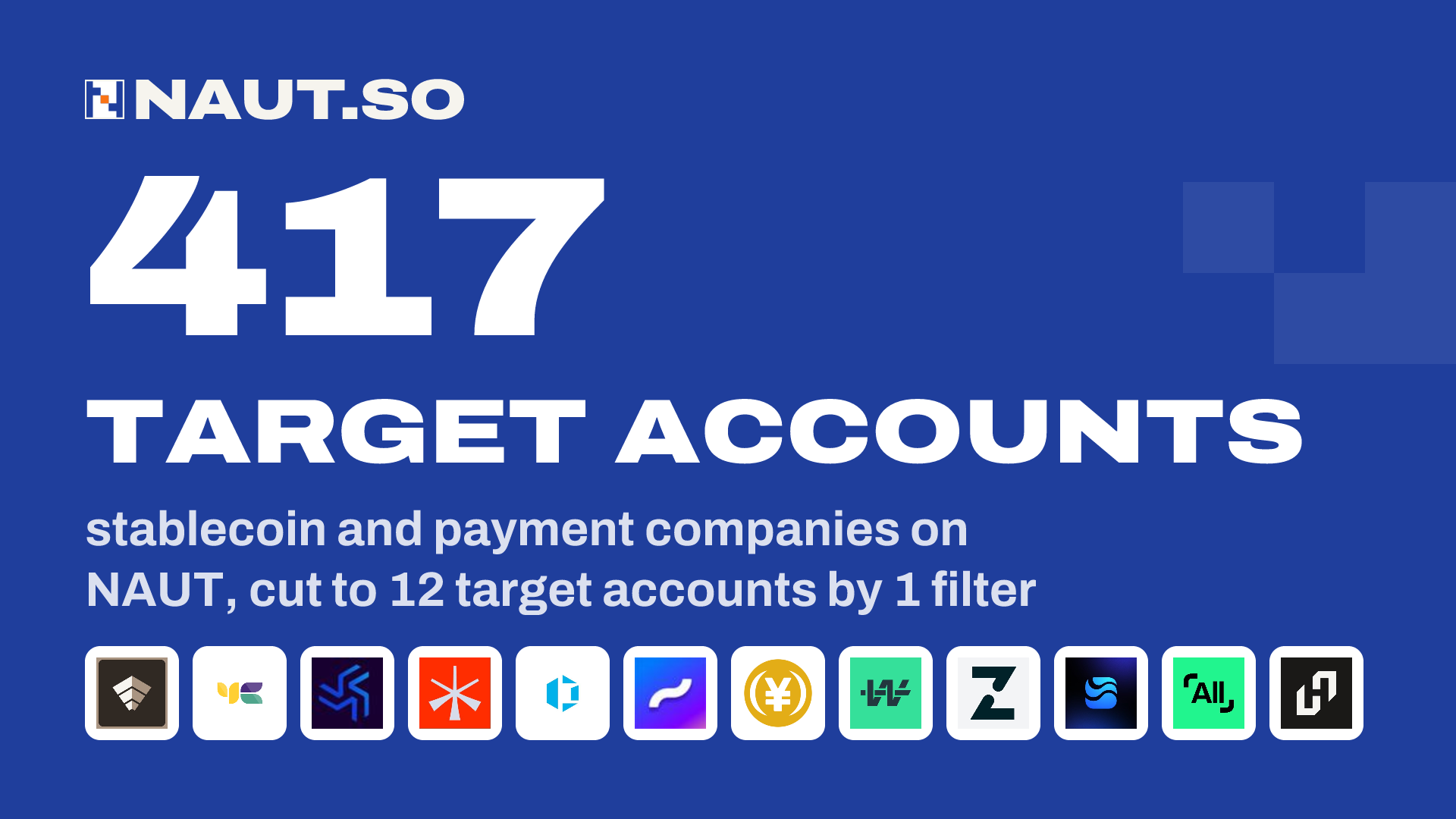
A target account list is built in 4 steps: write the ideal customer profile as 1 sentence, pull the whole universe that matches it from 1 source, filter that universe on a buying signal with a date on it, then tier what survives by fit. NAUT tracks 417 live companies tagged Stablecoins or Payment, and on 1 November 2026 only 13 of them had announced a funding round in the previous 365 days, which is the filter that turns a sector into a workable list of 12 accounts.
Data note. Every count here was read from NAUT's own database on 1 November 2026, read-only. The universe is the 417 live, published companies carrying the Stablecoins tag, the Payment tag or both. The buying signal is a funding round, disclosed or undisclosed, announced in the 365 days to 1 November 2026, which 13 of the 417 carry. Where NAUT holds more than 1 round inside that window for a company, the largest is the row used here, which is why Velocity sits on its $38M Series A of 14 July 2026 and not on the $10M Series A extension of September that NAUT also holds. 1 of those 13 was dropped because its NAUT sector tag disagreed with its own description, which reads as blockchain data infrastructure with no stablecoin or payment product, leaving 12 accounts. Each of the 12 rounds was checked against public reporting: 8 matched a page NAUT's checker could read, 3 (USD.AI (by Permian Labs), Walapay and JPY Coin) did not match the report on the date or the amount, and 1 (Noah) sits on a report whose wording the checker could not match on the page. Those 4 rows carry NAUT's own number here with no outside citation. 2 of the 12 rows, Walapay and JPY Coin, carry no description on NAUT, so only their round facts are stated. NAUT Research wrote it.
How to build a target account list in 4 steps
The 4 steps below are run in order, and each one is a filter that a later step cannot undo. The worked list uses stablecoins and payments as the sector, because that is where this quarter's crypto budgets sit, and the same 4 steps run on any sector tag NAUT carries.
- Define the ICP1 sentence naming what the account buys, the sector tag that finds it and the size band you can serve.
- Pull the universeNAUT holds 417 live companies tagged Stablecoins or Payment, the whole addressable set in 1 list.
- Filter on a buying signal13 of the 417 announced a funding round in the 365 days to 1 November 2026, a cut of 97%.
- Tier by fitThe 12 clean rows split 5, 4 and 3 across 3 tiers by round size and how recently the money landed.
Step 1: write the ideal customer profile as 1 sentence
An ideal customer profile that runs past 1 sentence is a wish list, and a wish list cannot be run as a query. Write it so that every clause maps to a field you can filter: what the account buys, the sector it sits in, the size band you can actually serve, and the region if your contract or licence limits you to one.
The sentence behind this worked list is: a stablecoin or payment company that has just taken outside money and now has a budget to spend on infrastructure. 3 clauses, 3 filters. The sector clause becomes a tag, the money clause becomes a date window, and the budget clause becomes the tier rule in step 4.
Say out loud which clause you will drop first if the list comes back too small, before you see the number. Deciding that afterwards is how an account list quietly turns back into the whole sector.
Step 2: pull the universe from 1 source, not 5
Pull every company that matches the sector clause, in 1 query, from 1 source. The point of this step is coverage, so no filtering happens here: a universe you assembled by hand from 5 newsletters has no denominator, and without a denominator you cannot tell a thin list from a thin market.
On NAUT that universe is 417 live companies on 1 November 2026, carrying the Stablecoins tag, the Payment tag or both. Every one of the 417 comes with its own page, a site, an X handle where NAUT holds one, and its funding rows, so the next 2 steps run on the same data rather than on a re-import.
A tag is a lead and not proof, and this is the step where that bites. Read each row's own description before you keep it. In this list 1 row carried the Stablecoins tag while its own description describes blockchain data infrastructure with no stablecoin or payment product, so it was dropped at step 3 rather than padding the count to 13.
Step 3: filter on buying signals with a date on them
Buying signals are events with dates, and the useful ones say that money has moved or that a team has grown. A funding round is the strongest of them for a crypto BD team, because it names the week a company went from no budget to a budget, and because it is public.
13 of the 417 companies announced a round in the 365 days to 1 November 2026. That is a cut of 97%, and it is the whole value of the step: 417 accounts is a market you read about, 13 is a week of calls. After dropping the 1 mistagged row, 12 accounts remain.
Pick the window on purpose. 365 days catches every team that raised inside a year, and inside it a shorter window separates the companies still deploying the money from the ones already through it. This list uses 120 days as that inner cutoff, which on 1 November 2026 means a round announced on or after 4 July 2026: 9 of the 12 clear it.
Step 4: tier by fit, and write the next move for each tier
A flat list of 12 gets worked top to bottom and abandoned at number 5. Tiering it does 2 jobs: it puts the best-fit accounts in front of your best hour of the day, and it records why each account sits where it does, so the next person to open the list does not re-argue it.
The rule here uses 2 fields only, round size and round recency, because both are in the data for every row and neither needs a judgment call. It is applied below on 1 November 2026.
| Tier | Rule | Accounts | First move |
|---|---|---|---|
| Tier 1 | A funding round of $10M or more, announced within 120 days | 5 | Call this week, reference the round |
| Tier 2 | A funding round under $10M, announced within 120 days | 4 | Call this month, pitch a smaller first scope |
| Tier 3 | Passed the filters another way: an acquisition, an undisclosed amount, or a round older than 120 days | 3 | Qualify before you spend a slot |
Tier 3 is where the rule earns its keep. Tazapay looks like the largest account in the list at $400M, and that figure is the price Circle agreed to pay to acquire it, announced on 8 September 2026, so the budget owner for anything you sell it is about to change. allscaleio disclosed no amount, and River (prev. Satoshi Protocol) raised in January 2026, which is 282 days before the read. All 3 are real accounts and none of them is this week's call.
Which companies made the target account list, and what did each raise?
These are the 12 companies that cleared all 4 steps, ranked by tier and then by the date the round was announced, newest first. Amounts are the figure NAUT's row holds for that round, and each row's sector tags are on its own NAUT page, 1 click from its name.
| Company | Tier | Round | Date | Raised |
|---|---|---|---|---|
 Noah |
1 | Extended Seed | 2026-10-07 | $16M |
 dtcpay |
1 | Extended Series A | 2026-09-18 | $15M |
 USD.AI |
1 | Debt Financing | 2026-09-15 | $40M |
 Yellow Card |
1 | Strategic | 2026-08-04 | $40M |
 Velocity |
1 | Series A | 2026-07-14 | $38M |
 hylo_so |
2 | Strategic | 2026-10-20 | $1M |
 Walapay |
2 | Seed | 2026-10-02 | $4.6M |
 JPY Coin |
2 | Extended Series B | 2026-08-05 | $6.35M |
 Pact Labs |
2 | Series A | 2026-07-14 | $7M |
 Tazapay |
3 | M&A | 2026-09-08 | $400M |
 allscaleio |
3 | Funding Round | 2026-06-25 | Undisclosed |
 River |
3 | Strategic Round | 2026-01-23 | $12M |
1 row will not match its own page. Velocity's row above is the $38M Series A of 14 July 2026, the largest round NAUT holds for it inside the window. NAUT's page for Velocity shows the later $10M Series A extension of September 2026, with Circle among its backers, and keeps the $38M round behind its "+2 more funding rounds" link, so the figure on the page will not be the figure in this table when you click through. Both rounds are the same Series A, $48M in total.
1 row to read twice before you pitch it. Yellow Card carries the Payment tag on NAUT while its own description reads as a cryptocurrency exchange, so an account list built for payment infrastructure should confirm the use case on the call rather than assume it from the tag.
How much did each account raise?
The 10 funding rounds with a disclosed figure add up to $179.95M, and the 5 tier 1 accounts hold $149M of it. The other 2 of the 12 are out of the chart: allscaleio disclosed no amount, and Tazapay's $400M is an acquisition price rather than money raised into the company.
What a target account list tells a crypto BD team
- The filter is worth more than the universe. 417 accounts and 12 accounts are the same market; the second one fits in a week.
- Size and recency disagree more often than a flat list admits. The smallest round in the list, $1M at hylo_so on 20 October 2026, is also the most recent.
- Warm intro paths are in the same data. NAUT's own backer record names a stablecoin issuer or a payments network on 3 of the 12 rounds: Tether as the lead at Pact Labs, Circle at Tazapay and Ripple as a participant, not the lead, in Velocity's $38M round. That count is what NAUT holds on those rows, so an empty backer list on the other 9 means NAUT has no backer on file for them.
- Date the list. 9 of the 12 rounds landed inside 120 days of the read, so the same query run a quarter from now returns a different tier 1.
- Start at tier 15 accounts raised $10M or more inside 120 days, from USD.AI (by Permian Labs) and Yellow Card at $40M each.
- Open each company pageAll 12 rows carry a site, and NAUT holds an X handle for every one of them.
- Ask for the warm intro3 of the 12 have Tether, Circle or Ripple on NAUT's backer record.
- Qualify tier 3 firstTazapay is being acquired and River (prev. Satoshi Protocol) raised 282 days before the read.
Related reading on NAUT: Crypto lead generation: 21 funded teams, 15 CEOs to pitch and How to find decision makers in a company: 5 steps for crypto.
Can you pull this data through the NAUT API?
Yes, in 2 calls. Step 2 of this build is GET https://api.naut.so/v1/projects?sector=Stablecoins&limit=100 with an Authorization: Bearer $NAUT_KEY header, repeating sector=Payment for the other half of the universe and paging through the result with page, and step 4 is GET https://api.naut.so/v1/projects/noah for 1 account with its team attached. Each data call costs 5 credits, so a 417-company universe at 100 rows a page plus the 12 account pulls runs under 100 credits on any plan at naut.so/pricing, and the parameters are documented at naut.so/docs/api. Verified Telegram, email and LinkedIn for the people on those accounts unlock on any paid NAUT plan, so start a 7-day trial before you work the list.
Target account list FAQ
How do you build a target account list for B2B sales?
In 4 steps: write the ideal customer profile as 1 sentence, pull the full universe that matches its sector clause from 1 source, filter that universe on a dated buying signal, then tier what survives by fit and write the first move for each tier. Run on NAUT's data on 1 November 2026, that took 417 stablecoin and payment companies down to 13 with a funding round in the previous 365 days, and to 12 after 1 mistagged row was dropped.
How many accounts should a target account list hold?
As many as your team can work in the cycle you are planning, which for 1 BD person is usually tens rather than hundreds. This worked list holds 12 accounts out of a 417-company universe, split 5 in tier 1, 4 in tier 2 and 3 in tier 3, so the tier 1 block is 1 week of calls.
What counts as a buying signal for crypto business development?
Buying signals are events with a date on them that say money has moved. A funding round is the one used here, because it is public and it dates the week a company gained a budget: 13 of NAUT's 417 live stablecoin and payment companies announced one in the 365 days to 1 November 2026, and 9 of the 12 clean rows landed inside the previous 120 days.
Where can I find these 12 stablecoin and payment accounts and their contact channels?
On NAUT. Each of the 12 has its own page with its sectors, its funding rows, its site and its X handle, reachable from the company's name in the table above, and the same rows come back through GET https://api.naut.so/v1/projects?sector=Stablecoins&limit=100 at 5 credits a call. Verified Telegram, email and LinkedIn for the people at those companies unlock on any paid NAUT plan, so start a 7-day trial to work the list end to end.
Is a target account list the same as an ideal customer profile?
No. The ideal customer profile is the 1-sentence rule, and the target account list is the set of named companies that rule returns on a given day. The rule here returned 12 accounts on 1 November 2026, and because 9 of those 12 rounds are inside a 120-day window, the same rule run next quarter returns a different set.
Sources
- NAUT's own database, read on 1 November 2026, read-only: the 417 live published companies tagged Stablecoins or Payment, each company's funding rows with the round type, announcement date and amount, each row's own description, and the backers NAUT records against each round. Every count above was computed from those rows at that time.
- dtcpay's September extension, reported at fintech.global, read on 1 November 2026. The report covers a Series A that grew to $25M in total; NAUT's row holds the $15M extension.
- Yellow Card's $40M strategic round of 4 August 2026, reported at bnnbloomberg.ca, read on 1 November 2026.
- Velocity's $38M Series A of 14 July 2026, reported at fintech.global, read on 1 November 2026, with Ripple among the participants. Its later $10M Series A extension of September 2026, which brought the Series A to $48M in total and which is the round NAUT's own page displays, reported at fintech.global, read on 1 November 2026.
- hylo_so's $1M strategic round of 20 October 2026, reported at cryptorank.io, read on 1 November 2026.
- Pact Labs' $7M Series A of 14 July 2026, led by Tether, reported at cryptobriefing.com, read on 1 November 2026.
- Circle's agreement to acquire Tazapay for $400M, announced 8 September 2026, reported at dealstreetasia.com, read on 1 November 2026.
- allscaleio's undisclosed strategic investment of 25 June 2026, reported at crypto.news, read on 1 November 2026.
- River (prev. Satoshi Protocol)'s $12M strategic round of 23 January 2026, reported at tracxn.com, read on 1 November 2026.
- The NAUT API parameters, prices and plans quoted in this article: naut.so/docs/api and naut.so/pricing, read on 31 October 2026.