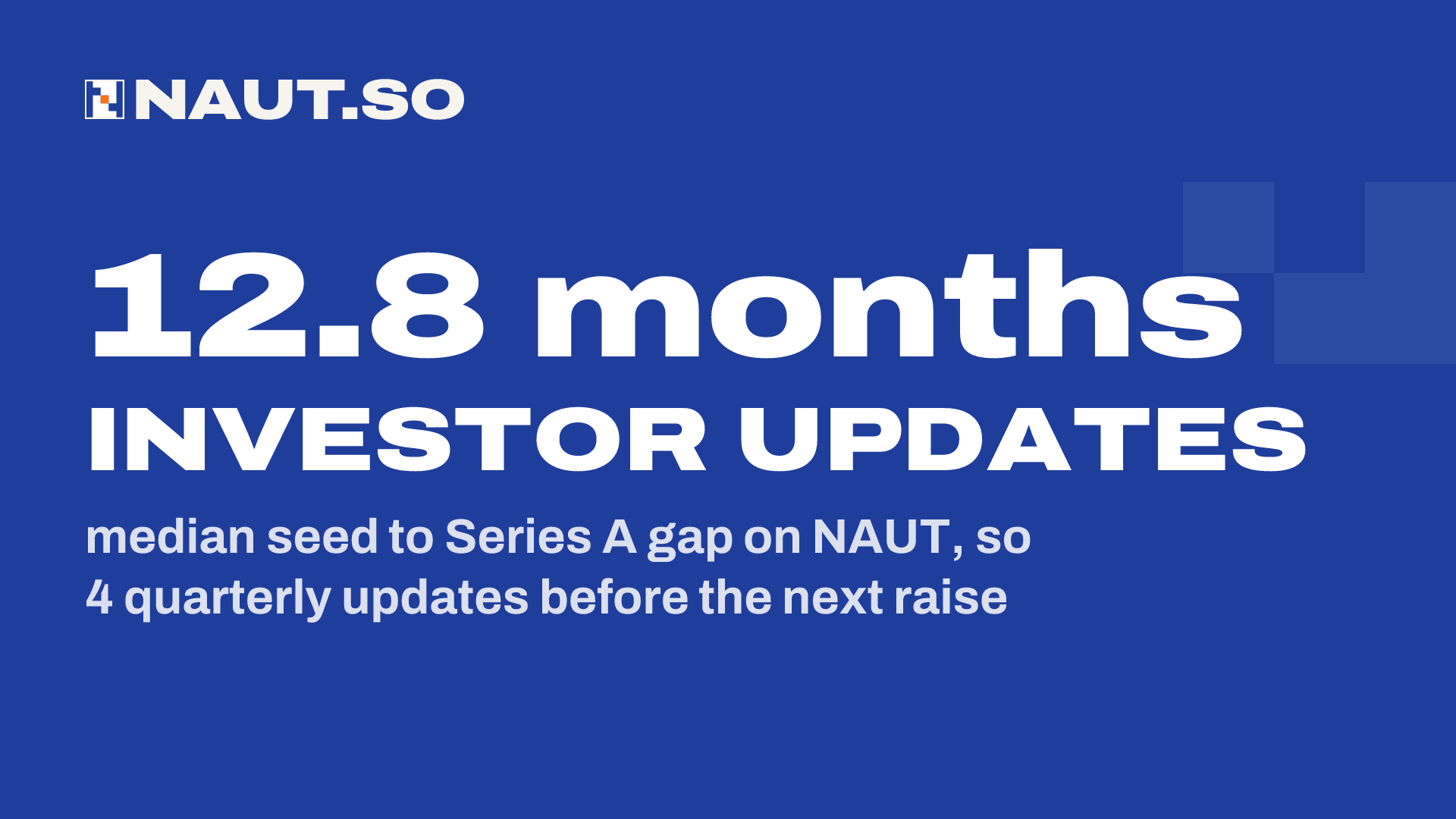
A crypto investor update template carries 7 fixed sections plus 1 stage-matched section, and NAUT's own round data sizes that last one: across 5,841 dated funding records held against live crypto companies, read on 9 November 2026, the median round is $2,000,000 at pre-seed, $3,000,000 at seed, $15,000,000 at Series A and $75,000,000 at Series B. NAUT tracks the gap between those rounds as well, and it is long: a median 12.8 months from seed to Series A across the 100 companies on NAUT's record that raised both in that order, with 104 of 691 seeded companies reaching a Series A at all. That is 4 quarterly updates between rounds at the median gap, and a 15.1% graduation rate for the backers reading them.
Data note. Every figure below is NAUT's own stored round record, read on 9 November 2026: 5,841 dated Investment rows against companies that are live on NAUT (not archived, not merged into another row). Round labels are free text, so they were bucketed by pattern into Pre-Seed, Seed, Series A and Series B; ambiguous labels (Pre-Series A, Series A2, Series A&B) were left out rather than guessed, so the stage counts here are a clean subset of the 5,841, never the whole table. The same read pulled the 2 worked examples below, Camp Network and Hashflow, from the 32 live companies holding exactly 1 priced seed round and 1 priced Series A round. 0 of these figures was put to an outside source, because each one is a count, a percentile or a stored round record from NAUT's own database rather than a claim about a rival product or a third-party survey. Written by NAUT Research.
What goes in a crypto investor update template at each stage?
The 7 fixed sections run the same at every stage. What changes is the 8th: the number your next round will be judged against. Stage medians on NAUT's record:
| Stage | Median round | Middle half | Companies |
|---|---|---|---|
| Pre-Seed | $2,000,000 | $1,200,000 to $3,000,000 | 58 |
| Seed | $3,000,000 | $1,800,000 to $5,700,000 | 691 |
| Series A | $15,000,000 | $9,000,000 to $25,000,000 | 211 |
| Series B | $75,000,000 | $41,000,000 to $165,000,000 | 76 |
The middle half is the 25th to 75th percentile of priced records. The company column counts distinct companies whose earliest round at that stage is on NAUT. The medians run off the priced records themselves, of which NAUT holds 55 at pre-seed, 703 at seed, 219 at Series A and 77 at Series B: a count that runs higher than the company count at seed and above because a company can hold more than 1 record typed at the same stage (an extension, a second tranche).
How much does each stage raise?
The 4 stages ranked by median round size on NAUT's priced records. The step from seed to Series A is 5x on the median and the step from Series A to Series B is 5x again, which is the single most useful line in any stage-matched update: a seed team writing to backers is 5x away from its next number, and the update is where that gap gets closed or does not.
How often should a crypto startup send an investor update?
Quarterly, because the median gap between rounds sits between 9 and 13 months at every step NAUT can measure, so a quarterly rhythm puts 3 or 4 updates between a round and the next one. Monthly is 12 or 13 sends over the same gap, which most founders stop doing by send 5.
| Gap | Median months | Middle half |
|---|---|---|
| Pre-Seed to Seed | 9.4 | 5.5 to 13.1 |
| Seed to Series A | 12.8 | 6.9 to 20 |
| Series A to Series B | 12.5 | 7.2 to 18.6 |
That is 3 quarterly updates across the pre-seed to seed gap and 4 across each of the other 2. The 3 rows rest on 19, 100 and 42 companies in order, counting only companies holding both rounds on NAUT with the later round dated after the earlier one. Those 100 sit against 104 seeded companies holding a Series A record at all: the 4 others carry a Series A dated on or before their seed round on NAUT's record, so they are out of the gap maths and in the graduation maths below.
The 25th to 75th spread matters more than the median for cadence. At seed to Series A, a quarter of the companies got there inside 6.9 months and a quarter took longer than 20 months. Writing 4 updates covers the median case; the plan should survive 7.
What does the median gap look like on a real company?
| Company | Seed | Series A | Months |
|---|---|---|---|
 Camp Network |
$4,000,000 on 2 April 2024 | $25,000,000 on 29 April 2025 | 12.9 |
 Hashflow |
$3,200,000 on 29 April 2021 | $25,000,000 on 21 July 2022 | 14.7 |
That is a 6.3x step-up for Camp Network and a 7.8x one for Hashflow. Both gaps sit on or above the 12.8-month median, so a founder on either path writes 4 or 5 quarterly updates between the 2 cheques. Hashflow's $3,200,000 seed is within $200,000 of the $3,000,000 seed median, and its Series A landed at $25,000,000, the 75th percentile of the Series A round size band. Each company's NAUT page carries those round records and its team, which is what a fund or a BD lead reads before replying to an update.
What odds are your backers pricing in?
| Step | Cohort | Reached | Share |
|---|---|---|---|
| Seed to Series A | 691 | 104 | 15.1% |
| Series A to Series B | 211 | 42 | 19.9% |
Both figures are NAUT's record of rounds it holds, not a claim about every crypto company in the world: a team that raised a Series A nobody announced, or one NAUT has not ingested, sits in the other 84.9% here. Read it as the share of NAUT-tracked seeded companies with a Series A on file. The use of it in an update is plain: a backer reading your quarter sees a Series A on file for 104 of 691 seed names, closer to 1 in 7 than 1 in 3, so the update's job is to put yours in that seventh with evidence rather than tone.
The crypto investor update template, section by section
Keep it to 1 screen. Send it as an investor update email, in the body, never as an attachment nobody opens.
- Headline and date. Company, stage, the quarter, and 1 sentence on where the quarter landed against the plan.
- Cash and runway. Cash on hand, monthly net burn, months of runway, and the date those 3 numbers are true as of. Runway in months is the only number every backer re-reads.
- The 3 metrics you named when you raised. Same 3, same definitions, every quarter, with last quarter beside this one. Changing the metric set reads as a miss.
- Token and treasury. Launched or pre-token; if launched, circulating share of supply, the next unlock date and size, and treasury split between stables and the token. If pre-token, say which quarter the decision lands in.
- Shipped and not shipped. 2 lines each. The not-shipped half is what builds the credit you will spend at the next raise.
- Team. Seats filled this quarter, seats open, and any seat vacated.
- Asks, named. 3 named intros, 3 named hires, or 1 named customer. A general ask for "any intros" returns nothing.
- Next round, stage-matched. The stage line from the table below: the round you are heading to, its median on NAUT, and the month you expect to be in market.
| Your last round | Next stage median | Months to it |
|---|---|---|
| Pre-Seed | $3,000,000 (Seed) | 9.4 |
| Seed | $15,000,000 (Series A) | 12.8 |
| Series A | $75,000,000 (Series B) | 12.5 |
| Series B | Outside these 4 buckets | Not measured here |
So a pre-seed team writes 3 quarterly updates before the next raise and a seed or Series A team writes 4. Series B is the last bucket this data set measures, so there is no Series C median or gap here to quote. A Series B team should set its own target and cadence and say so in the update rather than borrow a benchmark this read does not hold.
What this tells a founder raising the next round
- Write the next round's number into the update from the first quarter after the close. A seed team's target is read against a $15,000,000 Series A median, so a $6,000,000 ask needs a reason stated, and so does a $40,000,000 one.
- 4 updates is the median seed to Series A span. Build the metric story so that update 4 is the deck's first page, and so that update 7 still works if the gap runs to the 20-month 75th percentile.
- Good crypto startup investor relations is the paper trail: 4 dated quarters, same metric definitions, with misses named. That trail is what a new lead reads before the meeting, and 104 of 691 seeded teams on NAUT ever get that meeting.
- Ask for intros by name. Pull the funds that back your stage from NAUT's investor pages, list 3, and put those 3 in the asks section.
- Set the cadenceThe median seed to Series A gap is 12.8 months, so plan 4 quarterly updates before the next raise.
- Size the askName the Series A target against NAUT's $15,000,000 median and its $9,000,000 to $25,000,000 middle half.
- Fix the metricsLock the 3 metrics in update 1 and repeat the same 3 through update 4, misses included.
- Name 3 introsTake 3 funds active at your stage from NAUT's investor pages and ask for those 3 by name.
What this tells an investor or a BD lead
- The update you receive is a timing signal. Date the sender's last round on their NAUT page, add the median gap for their stage (9.4, 12.8 or 12.5 months), and you have the quarter they come back to market.
- A team 10 months past a seed round is in or near a Series A process now. The size to expect is the $9,000,000 to $25,000,000 middle half, with $15,000,000 as the median.
- For a BD lead selling to funded teams, the stage median is the budget read: a $3,000,000 seed company and a $75,000,000 Series B company are different buyers, and NAUT's company pages carry the round type, the amount and the announce date to tell them apart before the first message.
- Where a founder's update names no cash or runway line, that absence is the question for the next call.
- Date the last roundA company's NAUT page carries its round type, amount and announce date.
- Start the clockAdd 12.8 months to a seed date, or 12.5 to a Series A date, for the next raise window.
- Set the size bandExpect $9,000,000 to $25,000,000 at Series A and $41,000,000 to $165,000,000 at Series B.
- Find the senderEach NAUT page lists the team, with verified channels on any paid plan.
Related reading on NAUT: Crypto funding stages: 85 rounds, medians $1.85M to $60M and Crypto VC check sizes: 15 investors, $1.7M to $200M rounds.
Can you pull this data through the NAUT API?
Yes, for the fields behind every number here. A fund's portfolio call, GET https://api.naut.so/v1/investors/<fund-slug>, returns 1 row per backed round with the company, roundType, amountUsd, announceDate and isLead, which are the 4 stored fields this article's stage medians, 9.4 to 12.8-month gaps and 15.1% graduation rate are computed from, and GET https://api.naut.so/v1/investors?sort=portfolio&limit=100 lists the funds to walk. Each data call costs 5 credits on a plan from $49 a month; parameters and fields are at naut.so/docs/api and the plans at naut.so/pricing. Verified Telegram, email and LinkedIn for the people on those rounds unlock on any paid NAUT plan, so start a 7-day trial if you need to reach them.
Crypto investor update template FAQ
What should go in a crypto startup quarterly investor update?
8 sections: headline and date, cash and runway, the 3 metrics you named at the last raise, token and treasury position, shipped and not shipped, team seats, 3 named asks, and the next round sized against NAUT's stage median ($3,000,000 at seed, $15,000,000 at Series A, $75,000,000 at Series B on 5,841 dated round records read 9 November 2026). Keep it to 1 screen and send it in the body of an email.
How often should a crypto startup send investor updates?
Quarterly. NAUT's record of round-to-round gaps puts the median at 9.4 months from pre-seed to seed (19 companies), 12.8 months from seed to Series A (100 companies) and 12.5 months from Series A to Series B (42 companies), so a quarterly cadence yields 3 or 4 updates between rounds, with a 75th percentile of 20 months at seed to Series A for teams that take longer.
How big should I say my next round will be?
Say the stage median and your own reason for landing above or below it. On NAUT's priced round records, read 9 November 2026, the medians are $2,000,000 at pre-seed, $3,000,000 at seed, $15,000,000 at Series A and $75,000,000 at Series B, with the middle half of Series A rounds falling between $9,000,000 and $25,000,000.
What share of seeded crypto companies reach a Series A?
15.1% on NAUT's record: 104 of the 691 companies with a seed round on file also hold a Series A, and 42 of 211 Series A companies (19.9%) hold a Series B, read 9 November 2026. Those are the odds a quarterly update is written against, and they count rounds NAUT holds rather than every round ever raised.
Where can I find the funds that invest at my stage and how do I reach them?
NAUT's investor pages list funds with the rounds they backed, each carrying the round type, amount and announce date, which is how you shortlist by the stage medians in this article ($2,000,000 to $75,000,000 across the 4 stages). The same data comes through GET https://api.naut.so/v1/investors?sort=portfolio&limit=100, and verified Telegram, email and LinkedIn for each fund's team unlock on any paid NAUT plan, so start a 7-day trial to open the channels.
How this was measured
1 read-only query against NAUT's production database on 9 November 2026 pulled every dated Investment row joined to a live Company row (not archived, not merged): 5,841 records. Round labels were bucketed by pattern into the 4 stages, ambiguous labels excluded. Round sizes are medians and 25th and 75th percentiles of records with an amount above $0. Gaps use each company's earliest dated round per stage, counting only pairs where the later stage is dated after the earlier one. Graduation shares count companies holding both stages. No outside source was fetched for this article, because it makes no claim about a named company, a rival product or a third-party statistic.