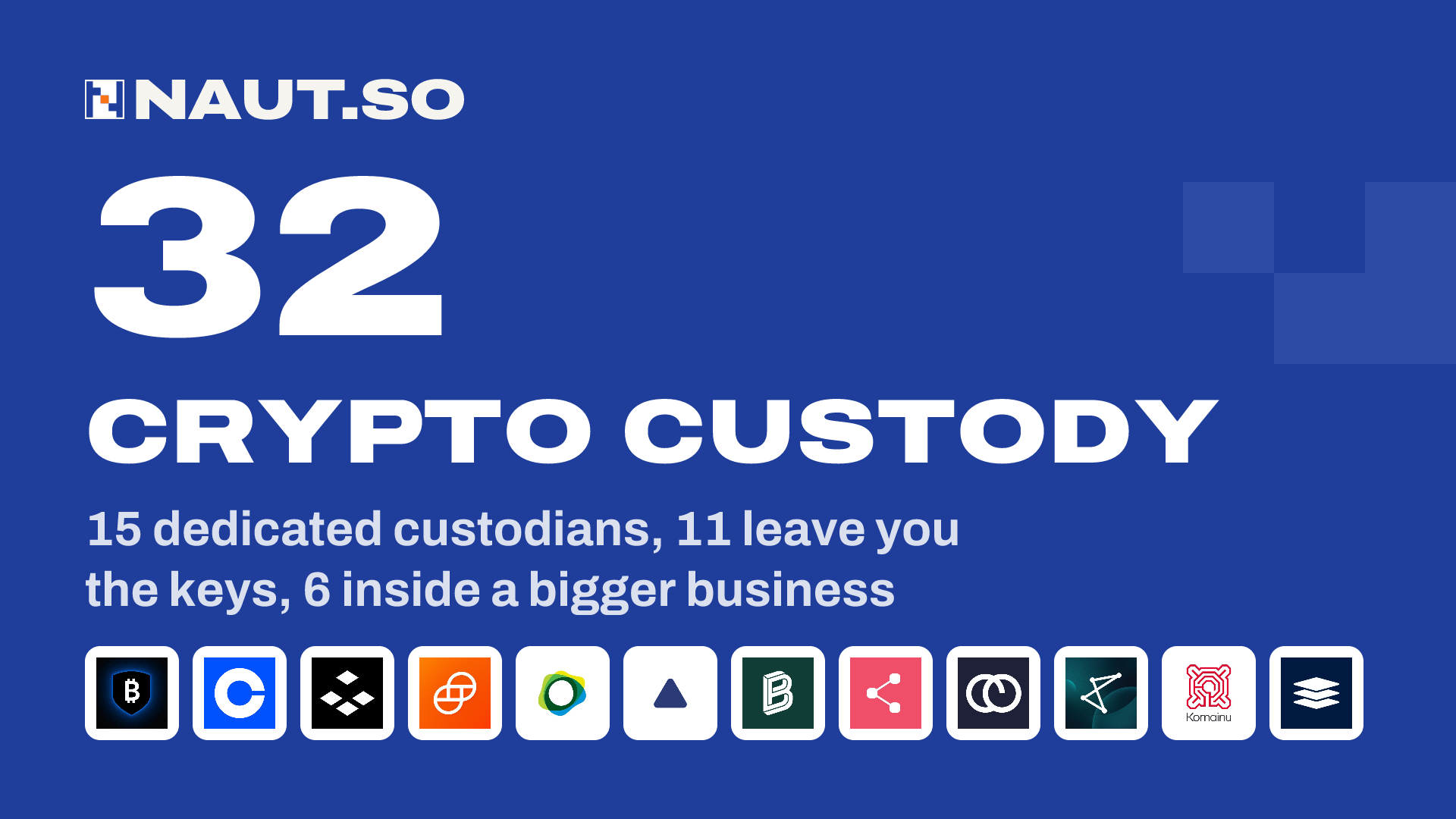
NAUT tracks 32 crypto custody providers whose own websites say they hold digital assets for clients or sell the software that holds them. 15 of the 32 are dedicated custodians, 11 leave the keys with the client, and 6 hold client assets inside a bigger exchange, bank or investing business. NAUT lists 230 people at 31 of them.
How this list was built: on 24 October 2026, NAUT checked the websites of 38 companies that it tags as custody providers or that are widely described as crypto custodians. A firm was kept only when its own site is live, still describes a custody business, and says in its own words what it does with client assets. 5 failed that test, and 1 more is counted under the group it belongs to:
- Propine: propine.com now redirects to an unrelated safari business, so it makes no custody claim of its own.
- Standard Custody & Trust: standardcustody.com redirects to Ripple, which acquired it in June 2024, so a trust charter sits in the same group as the custody software product listed below.
- Palisade: palisade.co redirects to the same acquirer's custody page, after the acquisition was announced in November 2025.
- Open Custody Protocol: the site that succeeded Qredo now leads with a merger into a yield project and no longer presents a custody business.
- BIT: bit.com names Cactus Custody as its custody arm, so the group is counted once, under Cactus Custody.
- Colossus Digital: colossus.digital sells institutional staking and yield infrastructure and is explicitly non-custodial, with client assets staying at the client's own custody provider.
The Team column is the count of people each firm's NAUT page lists on 24 October 2026; a dash means the page lists none yet. Well known custodians with no NAUT row, among them Copper, Taurus and Ceffu, are outside this count, and so is any NAUT row NAUT did not read on the day, among them Fidelity Digital Assets, whose business appears on NAUT under more than 1 row, and Hauck Aufhaeuser Digital Custody, whose row carries no website.
Which crypto custody providers are dedicated custodians?
These 15 firms sell institutional crypto custody and say on their own site that they hold, safeguard or take custody of clients' digital assets. What they share is the custody claim, not the product range: BitGo also sells self-custody wallets, Anchorage Digital trading and fiat banking, Fireblocks wallet infrastructure and DSRV validator operations. 13 of the 15 name a regulator or a licence somewhere on their own site.
| Firm | What its own site says | Team |
|---|---|---|
 BitGo |
Insured, regulated qualified custody with the keys held offline in cold storage, plus staking, trading, stablecoins and self-custody wallets | 11 |
 Anchorage Digital |
Qualified, federally regulated safekeeping on the same platform as trading, staking, fiat banking and settlement, from what it calls the first federally chartered crypto bank | 20 |
 Paxos |
Its trust company holds digital assets for institutions as a qualified custodian, with client assets segregated from company funds and kept bankruptcy remote | 10 |
 Komainu |
A regulated digital asset custodian with segregated on-chain wallets, tokenisation, collateral through its CORE product, and trading through partners while assets stay in custody | 6 |
 Zodia Custody |
Custody for financial institutions with air-gapped cold wallets, segregated accounts, 24/7 withdrawals, off-venue settlement through Interchange and a white-label option | 6 |
 Liminal Custody |
Institutional custody and wallet infrastructure, MPC and multi-sig wallets, staking and a white-label build, selling itself as a compliant and insured custodian | 4 |
 BDACS |
Institutional digital asset custody in Korea, saying it was the first in the country to win government certification for an institutional level custody system | 4 |
 CheckSig |
Custody, trading, staking and tax reporting from 1 account, with 2 levels of cold storage, 11 multi-signature keys and a public proof of reserves running since 2020 | 3 |
 Hex Trust |
Regulated institutional custody, escrow and staking plus an OTC desk, lending and fiat ramping, reporting $5B of assets under custody and 450+ clients | 2 |
 Fireblocks |
MPC wallet infrastructure, with qualified custody held by its own New York chartered trust company, where client assets are segregated and insolvency remote | 2 |
 DSRV |
Validator and node infrastructure, plus a custody product that keeps institutional assets in cold storage with air-gapped final signing | 2 |
 Tangany |
An API-first, cloud-based and fully white-label wallet-as-a-service custody platform, where the vendor itself holds the German crypto custody licence | 1 |
| Korea Digital Asset | Safekeeping for institutional clients in Korea, with 100% of customer assets in cold wallets, MPC storage, staking and corporate approval controls | 1 |
| Cactus Custody | Calls itself a qualified digital asset custodian solution for institutions, says safeguarding client assets is its core value, and keeps holdings in segregated on-chain addresses | 1 |
| Crypto Finance Group | A custody platform for financial institutions with full asset segregation, inviting them to outsource the custody of their own clients' assets. Part of Deutsche Boerse Group | - |
The 2 of the 15 that name no regulator anywhere NAUT read are BDACS, which claims a government certification without naming the body that gave it, and Cactus Custody, whose own domain cactuscustody.com refuses connections and whose live site is mycactus.com. 2 others name theirs away from the product page: Liminal Custody on its blog rather than its homepage, and Komainu on a separate entities page.
Which firms sell custody software instead of holding the assets?
These 11 firms sell wallet, key management or vault software, and on their own sites the keys stay on the client's side. AnchorWatch and The Vault each hold a key alongside the client rather than for the client.
| Firm | What its own site says | Team |
|---|---|---|
| Ripple | Custody software that banks and fintechs run in the cloud, on premise or hybrid while keeping their own keys. The site says the vendor cannot sign, freeze or access the assets | 11 |
| Utila | Enterprise MPC wallets and key management, where the organisation keeps full control of its keys across storage, issuance and transfers | 5 |
 Safe |
Onchain smart accounts for teams, sold as self-custody by default and positioned against custodial providers, running since 2017 | 5 |
 Dfns |
Wallet-as-a-service and key management across MPC, HSMs and TEEs. Its own site states it is a technology provider only and does not provide custody | 5 |
 Finoa |
Markets custody, in-custody staking and prime brokerage, while its own footer says the company is a technology infrastructure provider that does not provide custody or safekeeping | 4 |
 Fordefi |
An institutional MPC wallet and key management platform for DeFi and trading desks, where the client remains in full control of its private keys | 3 |
 AnchorWatch |
Bitcoin vault technology in 2 models: the client holds its own keys alongside the vendor, or keys are spread across 3 institutions, with optional Lloyd's of London cover | 2 |
 Asigna |
A smart multisig vault for the Bitcoin ecosystem. Its own docs call the security model fully non-custodial, with private keys staying with their owners | 2 |
 Cregis |
Custody infrastructure, wallet-as-a-service, MPC and HSM modules, so clients build and run their own custody service in a self-hosted environment | 1 |
 Vaultody |
Non-custodial MPC and TEE wallet infrastructure with distributed key generation and threshold signing. The tagline reads that custody stays with the client | 1 |
| The Vault | Custody, treasury, governance and compliance tooling, with the line that assets are never held on your behalf because every movement needs a quorum the client defines in which no participant, the vendor included, can act alone | 1 |
2 of those pages are worth reading twice. Finoa sells a product it calls custody and carries a footer saying it does not provide custody or safekeeping of crypto-assets. The Vault holds a CySEC crypto-asset service provider licence under MiCA and still writes that assets are never held on your behalf.
Which crypto custody providers sit inside a bigger business?
These 6 run a trading, banking or investing business first and hold client assets inside it.
- Coinbase, 41 people on NAUT: institutional custody through a chartered limited purpose trust company and qualified custodian, with cold storage vaults, staking and governance voting.
- HashKey Group, 40 people on NAUT: lists a custody business line beside its Hong Kong licensed exchange, offering institutional grade asset custody to clients.
- Bitpanda, 17 people on NAUT: a trading platform for 650+ cryptocurrencies, stocks, ETFs and metals that also sells enterprise custody to banks and fintechs, holding client assets in hardware security modules.
- Gemini, 9 people on NAUT: its trust company safeguards client assets as a New York trust company, fiduciary and qualified custodian, signing with MPC, holding funds 1:1 and naming $125M of insurance as of March 2024.
- Sygnum, 5 people on NAUT: a digital asset banking group with 1 account for custody, trading, lending, staking, payments and securities, naming its Protect product as bankruptcy-remote custody.
- Amdax, 5 people on NAUT: self-directed and managed crypto investing for Dutch clients, storing holdings in a full-reserve vault held 1-to-1, never lent out and audited to ISAE 3000.
What this tells a treasurer choosing a custodian
The question a buyer is really asking is who holds the keys, and the answer is on the vendor's own page if you look for it.
- 23 of the 32 firms name a regulator, a charter or a licence number somewhere on their own site. 2 of the 15 dedicated custodians do not.
- The charters are named, and they differ. BitGo, Anchorage Digital and Paxos name an OCC charter, Fireblocks, Coinbase and Gemini a New York trust charter, Tangany a BaFin licence, CheckSig a Consob MiCAR authorisation and Crypto Finance Group FINMA and BaFin.
- Match the jurisdiction to where your entity sits. Komainu names Jersey and Dubai, Hex Trust Singapore, Dubai and Hong Kong, Zodia Custody Abu Dhabi and Hong Kong, Korea Digital Asset Korea, and Crypto Finance Group Switzerland and Germany.
- Read past the product name. Finoa and Ripple both market a custody product and both state on the same site that the client keeps control of the assets.
- Check the domain still belongs to the firm. 3 of the 38 companies NAUT checked no longer run their own site.
- Decide who holds the keys15 of the 32 firms are dedicated custodians, 11 leave the keys with you.
- Read the licence on the page13 of the 15 custodians name a regulator, from an OCC charter at BitGo to a BaFin licence at Tangany.
- Match the jurisdictionLicences run from Jersey and Dubai at Komainu to Switzerland and Germany at Crypto Finance Group.
- Find the decision makerNAUT lists 230 people at 31 of the 32 firms, 41 of them at Coinbase and 20 at Anchorage Digital.
Crypto custody providers FAQ
Who are the crypto custody providers?
As of 24 October 2026, NAUT tracks 32 crypto custody providers. 15 are dedicated custodians, among them BitGo, Anchorage Digital, Paxos, Komainu, Zodia Custody, Fireblocks and Hex Trust.
What is the difference between a crypto custodian and custody software?
A custodian holds the client's digital assets and usually answers to a regulator for doing so. Custody software leaves the keys on the client's side: on 24 October 2026, 11 of the 32 firms on this list sell the software rather than the service, and Ripple, Utila, Fordefi and Vaultody each state on their own pages that the client keeps control.
Which crypto custodians are regulated?
13 of the 15 dedicated custodians name a regulator or licence somewhere on their own site as of 24 October 2026. BitGo, Anchorage Digital and Paxos name an OCC charter, Fireblocks an NYDFS trust charter, Tangany a BaFin crypto custody licence numbered 50085612, and CheckSig a Consob authorisation under MiCAR.
Do exchanges offer crypto custody?
Some do. As of 24 October 2026, 6 of the 32 firms on this list hold client assets inside a bigger business, and 3 of those are exchanges: Coinbase and Gemini each custody through their own chartered trust company, and HashKey Group lists a custody business line beside its Hong Kong licensed exchange. The other 3 are not exchanges: Sygnum is a digital asset bank, and Bitpanda is a trading platform that holds client assets in hardware security modules, and Amdax an investing platform with its own full-reserve vault.
Which crypto custody providers say they are insured?
At least 7 of the 32 name insurance on the pages NAUT read on 24 October 2026: BitGo sells what it calls insured qualified custody, Hex Trust calls its custody insured and regulated, Liminal Custody describes itself as an insured custodian, AnchorWatch is a Lloyd's of London coverholder underwritten by Arch Insurance UK, Gemini named $125M of cover as of March 2024, Korea Digital Asset names a KB Insurance policy, and Fordefi names Munich Re. A named policy is not a proof of cover, and none of the pages NAUT read sets out the policy's scope or exclusions.
Sources
- Each firm's own website, read on 24 October 2026: bitgo.com, anchorage.com, paxos.com, komainu.com, zodia-custody.com, liminalcustody.com, bdacs.co.kr, checksig.com, hextrust.com, fireblocks.com, dsrv.com, tangany.com, kodax.com, mycactus.com, crypto-finance.com, ripple.com, utila.io, safe.global, dfns.co, finoa.io, fordefi.com, anchorwatch.com, asigna.gitbook.io, cregis.com, vaultody.com, thevault.inc, coinbase.com, group.hashkey.com, bitpanda.com, gemini.com, sygnum.com, amdax.com
- The 6 companies checked and not counted as separate firms, 24 October 2026: propine.com, standardcustody.com, palisade.co, opencustody.org, bit.com, colossus.digital
- Team counts and the firm list: each firm's NAUT page, 24 October 2026